Connect models and coding agents, launch work with an explicit workspace and runtime posture, review approvals and diffs, and trace what happened—from one operator console.
ACP clientsUse Hecate's native runtime through hecate acp serve
External Agent CLIs are installed separately. Their vendor accounts, billing, and internal runtime stay with them.
Operator loop
From intent to evidence.
Prepare the work, run the right agent, follow what happens, and review the result without losing the execution boundary.
01
Configure
Connect model providers and choose the workspace. Agent Presets shape model routing, instructions, and Hecate-owned execution posture; External Agent presets select the agent and its launch options.
02
Launch
Start a Hecate Chat, queue a durable Hecate-native Task, or open a supervised External Agent session through ACP.
03
Supervise
Follow streamed activity, stop work, and resolve approvals when Hecate policy or an External Agent requests them.
04
Review
Inspect final output, artifacts, Git diffs, route decisions, traces, token usage, and provider-reported cost where available—then retry, resume, or hand the work off.
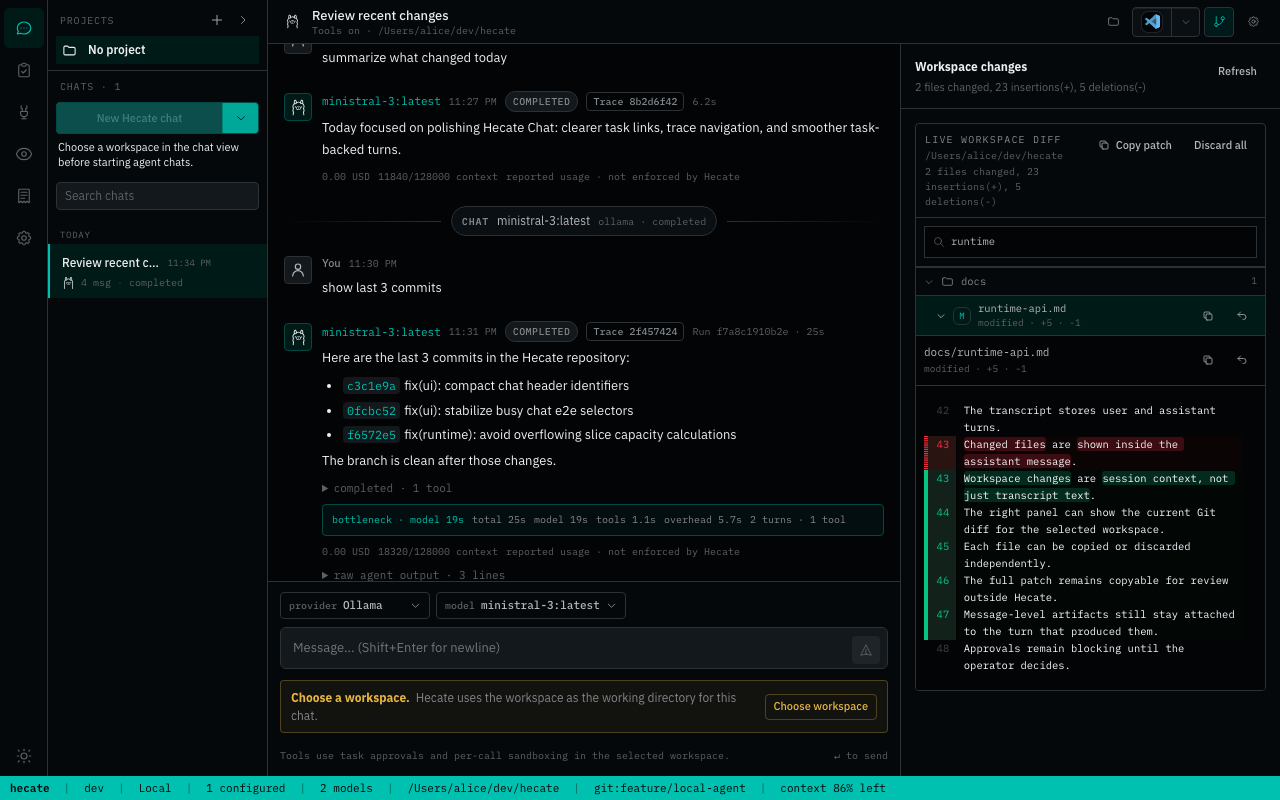
Chat, Task Run, trace, and workspace changes stay connected.
Change review
Review the work, not just the answer.
Keep the transcript beside its Task Run, trace, files, and Git diff. Hecate preserves the evidence needed to understand what changed and why.
Agent Client Protocol
ACP works in both directions.
Use Hecate as the console around external agents, or use Hecate's native runtime from another ACP-capable client.
Agents → Hecate
Supervise external agents.
Codex, Claude Code, Cursor Agent, and Grok Build connect through ACP. Hecate adds session supervision, optional diagnostics, permission handling, and Git diff review without taking over their accounts or internal runtime.
Hecate → ACP clients
Bring the native runtime with you.
hecate acp serve turns ACP prompts into durable Tasks and Runs while Hecate retains routing, policy, approvals, artifacts, and observability.
Portable coordination. Enforced execution.
Embedded Cairnline owns portable project identity, roles, work items, assignments, and handoffs. Hecate resolves that intent into presets, routes, workspaces, and execution; coordination records never grant runtime permission by themselves.
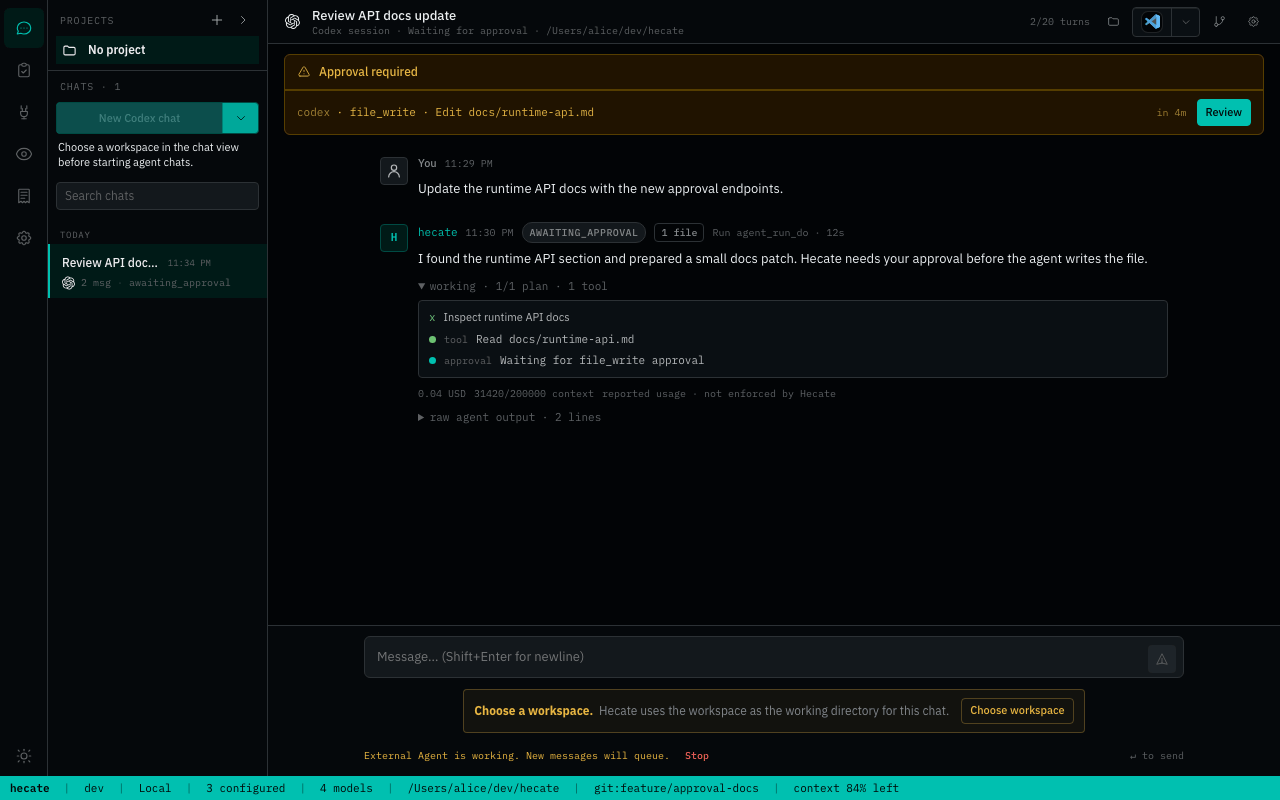
Hecate-native Tasks keep tool posture, blocking approvals, artifacts, and run state in view. External Agent approvals appear when their ACP adapter requests permission; Hecate does not claim universal interception inside a vendor CLI.
A native file-write approval blocks the Task Run before execution.
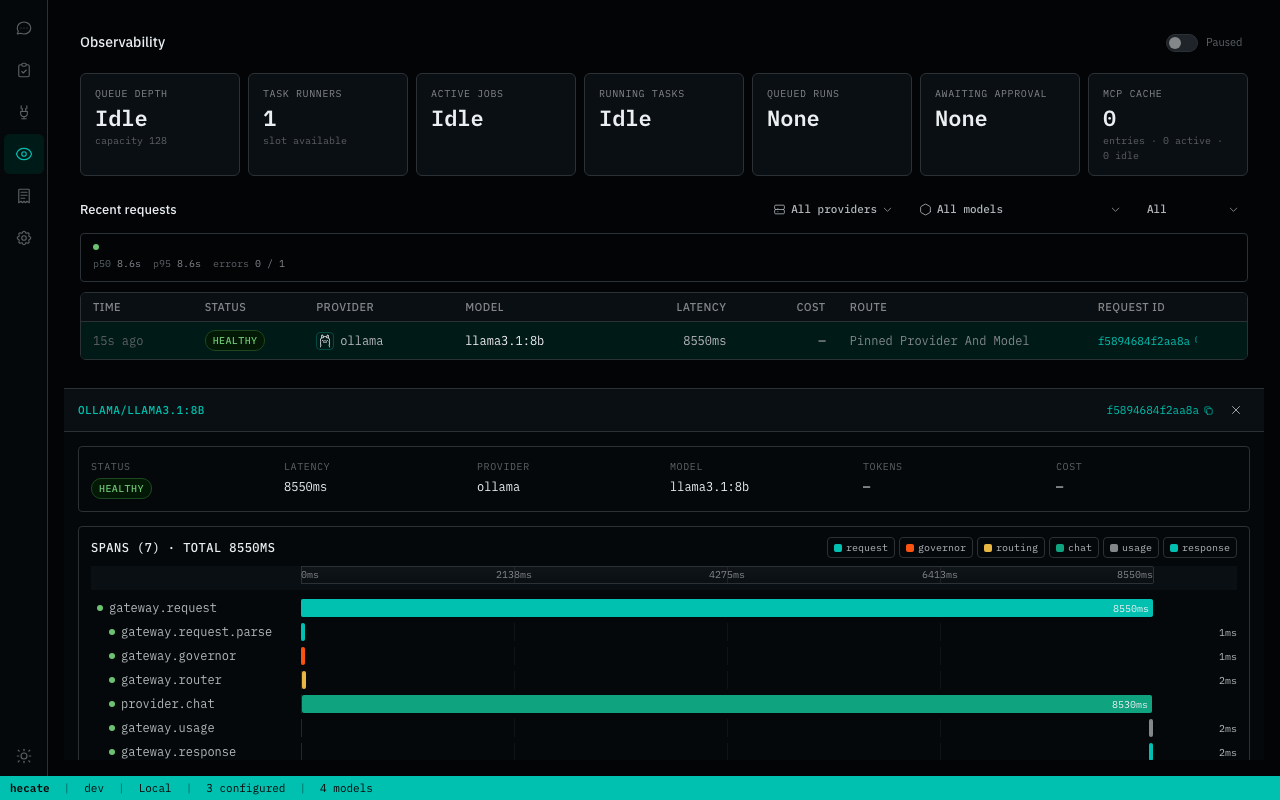
Route reports and OpenTelemetry traces explain what happened.
Observability
Understand every route and run.
Inspect route choices, skipped providers, timing, trace spans, token usage, and provider-reported cost where available. The trace ID stays attached to the work that produced it.
Run it where the work lives
Desktop, Docker, source, or Cloud.
Start with the desktop app, run Hecate on infrastructure you control, or use Hecate Cloud for hosted and authenticated remote access.
Linux and Windows bundles are CI-built but have not completed the same real-machine installation smoke tests as macOS Apple Silicon.
Execution boundary
Know what Hecate controls.
Native Tasks are supervised execution, not a VM.Hecate applies workspace, process, Git, policy, and approval seams, with OS isolation wrappers where available.
External Agents remain trusted subprocesses.Install them from sources you trust; Hecate does not sandbox or authenticate their internal runtime.
Local is a default boundary, not the whole product.Hecate binds to loopback by default and can also run behind an authenticated access layer or as a hosted runtime.